By Margaret Dillard
In today’s challenging restaurant landscape, owners face a difficult dilemma: rising costs are squeezing margins, but raising prices risks losing customers. The good news? There’s a third option that most restaurants overlook—implementing simple, daily cost-control habits that protect profitability without touching your menu prices.
After working with restaurant clients, I’ve seen firsthand how small operational changes can yield significant financial results. Here’s a comprehensive framework that transforms cost control from an abstract goal into concrete daily actions your entire team can embrace.
The Real Cost of Inaction
Before diving into solutions, let’s acknowledge the stakes. A restaurant operating at 5% profit margins (industry average) can see those margins evaporate with just a 2-3% increase in food or labor costs. Without intervention, this forces the dreaded choice: raise prices or close your doors.
But here’s what many owners miss: most restaurants have 5-15% waste already built into their operations. Capturing even half of that waste means the difference between struggling and thriving.
Six Pillars of Restaurant Cost Control
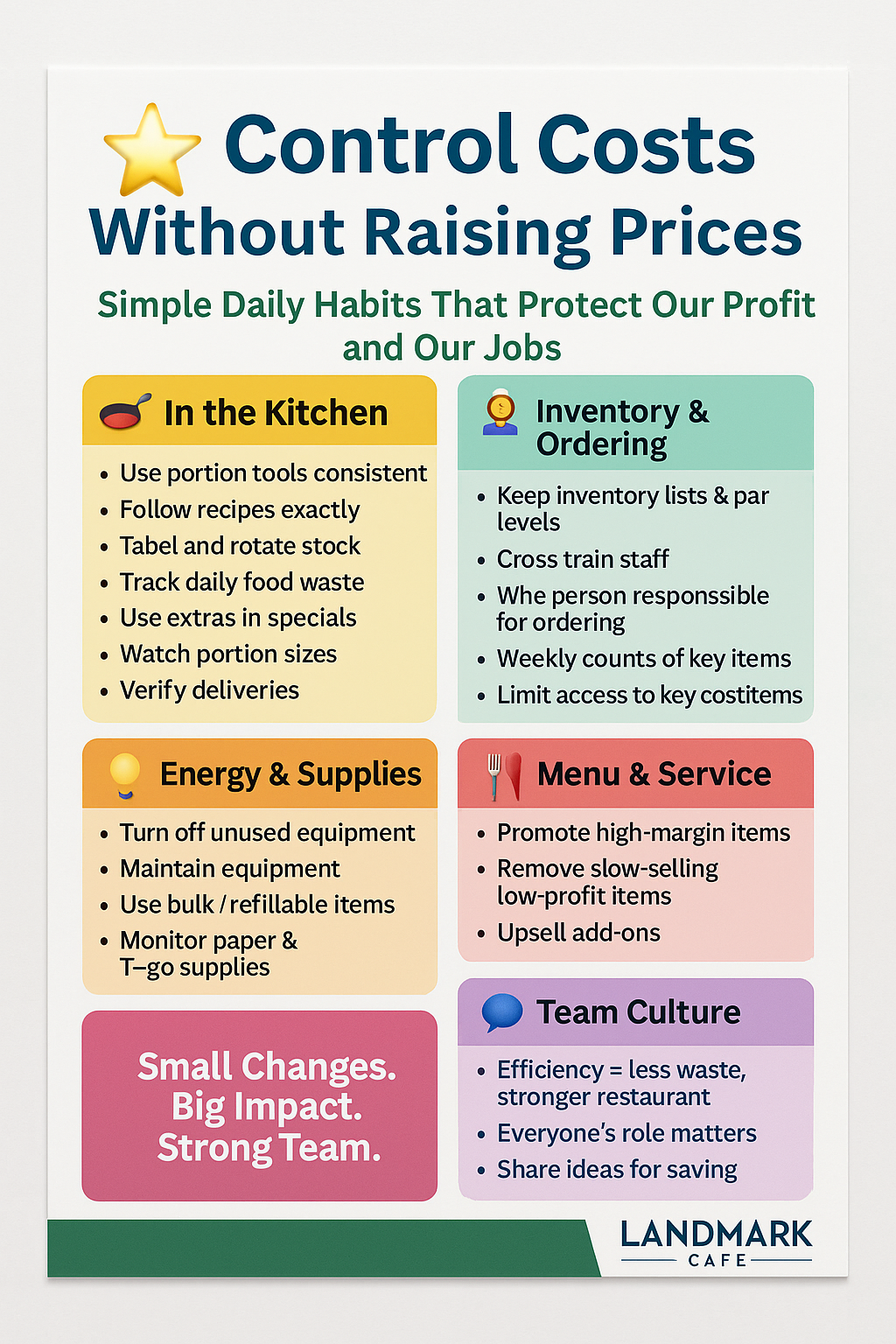
1. Kitchen Operations: Where Pennies Become Dollars
The kitchen is where most profit leaks occur, but it’s also where you have the most control. Implement these non-negotiables:
- Standardize portions religiously. Use scoops, ladles, and scales—not eyeballing. A few extra ounces of protein per plate adds up to thousands annually.
- Follow recipes exactly. Recipe drift is real. When cooks add “just a little more” of expensive ingredients, costs spiral.
- Master FIFO (First In, First Out). Label everything with dates. Rotate stock properly. Spoilage is silent profit theft.
- Track waste daily. A simple log showing what gets tossed and why creates accountability and reveals patterns.
- Prep smaller batches. Better to prep twice than throw away excess that doesn’t sell.
- Turn extras into opportunities. Day-old bread becomes croutons. Vegetable scraps become stock. Creativity reduces waste.
- Verify every delivery. Count items, check quality, weigh boxes. Vendors make mistakes—catch them.
2. Inventory & Ordering: The Foundation of Control
Poor inventory management is like driving blindfolded. You need visibility:
- Establish par levels for everything. Know your ideal quantity for each item based on actual usage patterns.
- Order based on data, not gut feeling. Review sales reports and current inventory before every order.
- Assign one responsible person. Multiple people ordering creates duplication and confusion.
- Conduct weekly spot counts. You don’t need full inventory weekly, but check your top 20 high-cost items.
- Limit access to expensive items. Lock up high-cost proteins, alcohol, and specialty ingredients.
Pro tip: Your inventory turnover ratio should be 4-6 times monthly for most restaurants. Lower means you’re tying up cash in stock; higher might mean you’re running too lean and risking stockouts.
3. Labor Efficiency: Your Biggest Controllable Expense
Labor typically represents 25-35% of restaurant costs. Small scheduling improvements create massive savings:
- Schedule to sales patterns, not habits. Use your POS data. If Tuesday lunch is consistently slow, reduce staffing.
- Cross-train relentlessly. A server who can prep and a cook who can expo creates scheduling flexibility.
- Eliminate downtime. Slow periods should mean prep work, deep cleaning, training—never idle time.
- Make productivity visible. When everyone knows their role in efficiency, performance improves.
- Celebrate efficiency wins. Recognize staff who find smarter ways to work. Culture drives behavior.
4. Energy & Supplies: Death by a Thousand Cuts
Utilities and supplies seem minor until you calculate annual costs:
- Turn off equipment when not needed. That oven doesn’t need to preheat for three hours.
- Maintain equipment proactively. A poorly maintained refrigerator uses 20% more energy.
- Buy supplies intelligently. Bulk purchasing and refillables reduce both cost and waste.
- Monitor paper goods and to-go supplies. These costs have exploded. Track usage and find alternatives.
- Create closing checklists. Lights, HVAC, equipment—what gets checked gets done.
5. Menu Engineering: Strategic Profitability
Your menu is a profit tool, not just a list of dishes:
- Promote high-margin items. Train staff to suggest these. Feature them visually on the menu.
- Eliminate the losers. If it’s slow-selling AND low-profit, it’s hurting you twice. Remove it.
- Consistency builds trust. Customers return when they know what to expect. Train for consistency.
- Master the upsell. “Would you like to add avocado?” generates pure margin.
Key insight: Most restaurants have 20% of menu items generating 80% of profit. Identify yours and double down on promoting them.
6. Team Culture: The Multiplier Effect
All the systems in the world fail without cultural buy-in:
- Connect the dots. Help staff understand that efficiency protects their jobs and enables raises.
- Make everyone’s role matter. From dishwasher to manager, everyone impacts profitability.
- Create idea channels. Your staff sees waste you don’t. Reward suggestions that save money.
- Celebrate wins publicly. Weekly huddles highlighting cost-control victories build momentum.
Implementation: From Theory to Practice
Reading this is easy. Doing it is hard. Here’s how to start:
Week 1: Pick ONE category above and implement TWO specific actions. Master those before moving on.
Week 2-4: Add one new action weekly. Build habits gradually.
Month 2: Expand to a second category. Don’t rush—sustainable change takes time.
Month 3: Review your financials. You should see measurable improvement in food cost percentage and labor percentage.
The Bottom Line
Cost control isn’t about being cheap—it’s about being smart. It’s the difference between reacting to market pressures with panic price increases versus proactively managing your business with confidence.
Small changes compound. A restaurant saving just 2% on food costs and 3% on labor while maintaining quality and service doesn’t need to raise prices. Better yet, those savings can fund staff raises, equipment upgrades, or marketing—investments that grow the business rather than just surviving.
The restaurants thriving in today’s market aren’t necessarily the ones charging the most. They’re the ones running the tightest operations while delivering exceptional experiences.
Your competitors are struggling with the same cost pressures. The question is: who will respond more strategically?
About Margaret Dillard
Margaret Dillard helps restaurant owners and hospitality businesses build sustainable profitability through strategic operations and marketing. With over a decade of experience in the food service industry, she specializes in practical, implementable solutions that drive real results.
Ready to transform your restaurant’s profitability? Visit margaretdillard.net to learn more about consulting services and resources for restaurant owners.
Related Resources:
- Download: Free Restaurant Cost-Control Checklist
- Guide: Menu Engineering for Maximum Profitability
- Workshop: Staff Training Systems That Actually Work
Share this article with a restaurant owner who needs it.
Leave a Reply